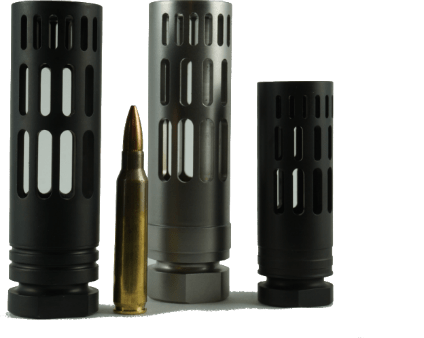
Technical Background of SMI’s Recoil and Blast Control Device – the Attenu8tor
Revolutionary: radically new or innovative; outside or beyond established procedure, principles, etc. (from www.Dictionary.com)
When a business releases a new product into the marketplace, the release is frequently accompanied by a claim that the product’s design is “revolutionary”. Unfortunately, all too often buyers discover that the claim over-exaggerated, as real world experience with the product accumulates. Keeping that in mind, based upon the rigorous, integrated design and test protocol used in its development, we at SMI are confident that real world experience will continue to confirm that the patented design of our recoil and blast control device – the Attenu8tor – is truly revolutionary. Please follow along to learn why.
The basic laws of Physics dictate that the firing of any firearm produces a number of unavoidable side effects. For many rifle shooters, the least pleasant of these side effects is the recoil-induced “sore shoulder” they experience after visiting the range. Likewise, many pistol shooters experience recoil-induced soreness in their hands after a range session. For those who shoot more powerful, harder-recoiling rounds, shooting only a few rounds can be enough to cause considerable shoulder or hand pain, which in some cases can cause the shooter to develop a flinch that can seriously affect their accuracy and oftentimes be difficult to cure.
Another side effect that bothers many shooters is actually a combination of all the events we lump together under the term “muzzle blast”. Caused by the expanding burst of propellant gas as it exits the muzzle, these effects include muzzle “flip”, the propagation of noise and concussive pressure waves, the flash of unburned powder as it encounters atmospheric oxygen, and other annoying effects such as dust kicked up from the ground or mat when shooting prone.
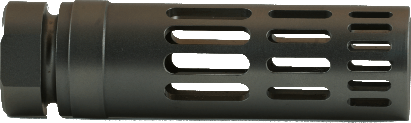
A wide variety of muzzle devices have been developed to reduce or eliminate these side effects. However, all of the devices on the market today emphasize the reduction of only one or two of these side effects, often at the expense of increasing the intensity of one or more of the other side effects. There are four commonly-identified categories of muzzle device that shooters can install on their firearms in order to control side effects:
- Flash Hiders – mix air and unburnt powder in the propellant gas as it leaves the muzzle to burn the powder in a manner that reduces the flash from the burning process.
- Compensators – counteract the vertical movement, or “muzzle flip” of the gun when it is fired.
- Muzzle Brakes – reduce the recoil felt by a shooter when the gun is fired.
- Combination or Hybrid Devices – combine two or more of the first three device categories into one unit.
There is also a fifth category of muzzle device that is rarely considereded; a category which we feel is best described as a Blast Controller. Anyone who has stood next to someone shooting a rifle with a poorly-designed Muzzle Brake is all too familiar with the side effects caused by this category of blast effect – the noise and pressure waves such a device propagates in an uncontrolled fashion to either side of the shooter. In many cases, these “blast waves” are so massive that they make it extremely uncomfortable for anyone to occupy a position on either side of the shooter.
The novel, patented design of SMI’s Attenu8tor is completely unlike that of any flash hider, compensator, muzzle brake, or any combination or hybrid muzzle device currently on the market. The Attenu8tor has a unique multi-chamber configuration which is specifically designed to provide simultaneous, optimized reduction of all recoil and blast effects.
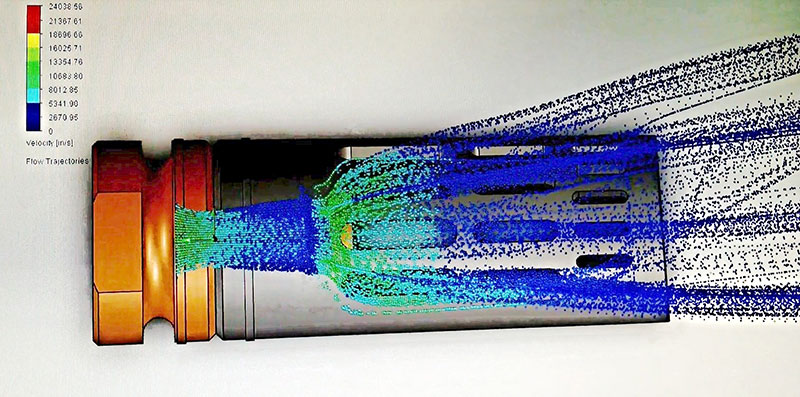
The design of SMI’s Attenu8tor directs the full force of the expanding, high pressure propellant gas to begin minimizing recoil and blast effects as soon as the base of the bullet exits the muzzle. When the base of the bullet exits the muzzle, the high pressure propellant gas behind it flows instantly into the Attenu8tor’s primary chamber, which acts as a kind of recoil “shock absorber”. The gas strikes the front wall of the primary chamber, immediately providing a forward push to reduce felt recoil. Simulation model results indicate that the temperature of the front wall of the primary chamber also increases almost instantaneously as a result of the gas strike, thus aiding in the combustion of any remaining powder residue.
At the same time – and before the bullet has left the Attenu8tor – a series of precision-drilled orifice jets in the front wall of the primary chamber direct and accelerate gas flow into the secondary chamber, where it again strikes a series of walls to further reduce felt recoil, and where a series of precisely-shaped slots control gas flow to reduce all blast effects. The configuration of the secondary chamber vent slots is designed to both precisely direct and distribute the flow of the propellant gas so that muzzle flip as well as all concussive and pressure wave effects are significantly reduced, and to mix the propellant gas with outside air to aid in further combustion of any remaining powder residue.
By directing the flow of the high pressure gas as it exhausts from the secondary chamber, the Attenu8tor’s vent slots direct any residual muzzle flash so that it does not affect the shooter’s visual acuity and use of the rifle’s sights for follow-up shots. In addition, flow of the exhausted gas is directed specifically to increase muzzle stability and to reduce both muzzle flip and the effects of blast and concussion on the shooter, as well as on any neighboring shooters.